
Community, infrastructure, and the future of open research
On 15 April 2026, CORE welcomed its global community of members to the biannual Board of Supporters meeting , a session that brought together strategic updates, collaborative discussions, and forward-looking priorities shaping the future of open research infrastructure.
With participation from repository managers, institutional stakeholders, and CORE leadership, the meeting reinforced one central theme: community-led development remains at the heart of CORE’s evolution.
Strengthening CORE’s role in the open research ecosystem
Opening the session, Prof Petr Knoth, Head of CORE, shared a strategic update, highlighting progress across infrastructure, integrations, and research initiatives.
A key development is the introduction of CORE’s distinctive characteristics framework, designed to clearly articulate CORE’s position within the open scholarly infrastructure landscape. This initiative strengthens transparency around both CORE’s data principles and its community-driven governance model.
Significant progress has also been made in repository integrations, particularly through collaboration with 4Science to enhance DSpace functionality. These integrations aim to:
- Reduce duplication through metadata pre-fill
- Enrich records with Sustainable Development Goals (SDGs)
- Extract Rights Retention Statements (RRS)
Together, these improvements signal a move towards more interoperable repositories.
Scaling infrastructure for a growing ecosystem
CORE continues to scale rapidly. Over the past nine months alone:
- Millions of new full-text records have been indexed
- Tens of millions of metadata records have been added
- Over 1,000 new repositories have joined the network
To support this growth, CORE is nearing completion of a major cloud infrastructure migration, enabling greater scalability and resilience.

Responding to change: tools, services, and gaps
A major theme across the meeting was the changing service landscape.
With the planned decommissioning of tools such as IRUS-UK and Publications Router, the community raised concerns around:
- Loss of usage tracking
- Gaps in content discovery workflows
- Reduced visibility of repository performance
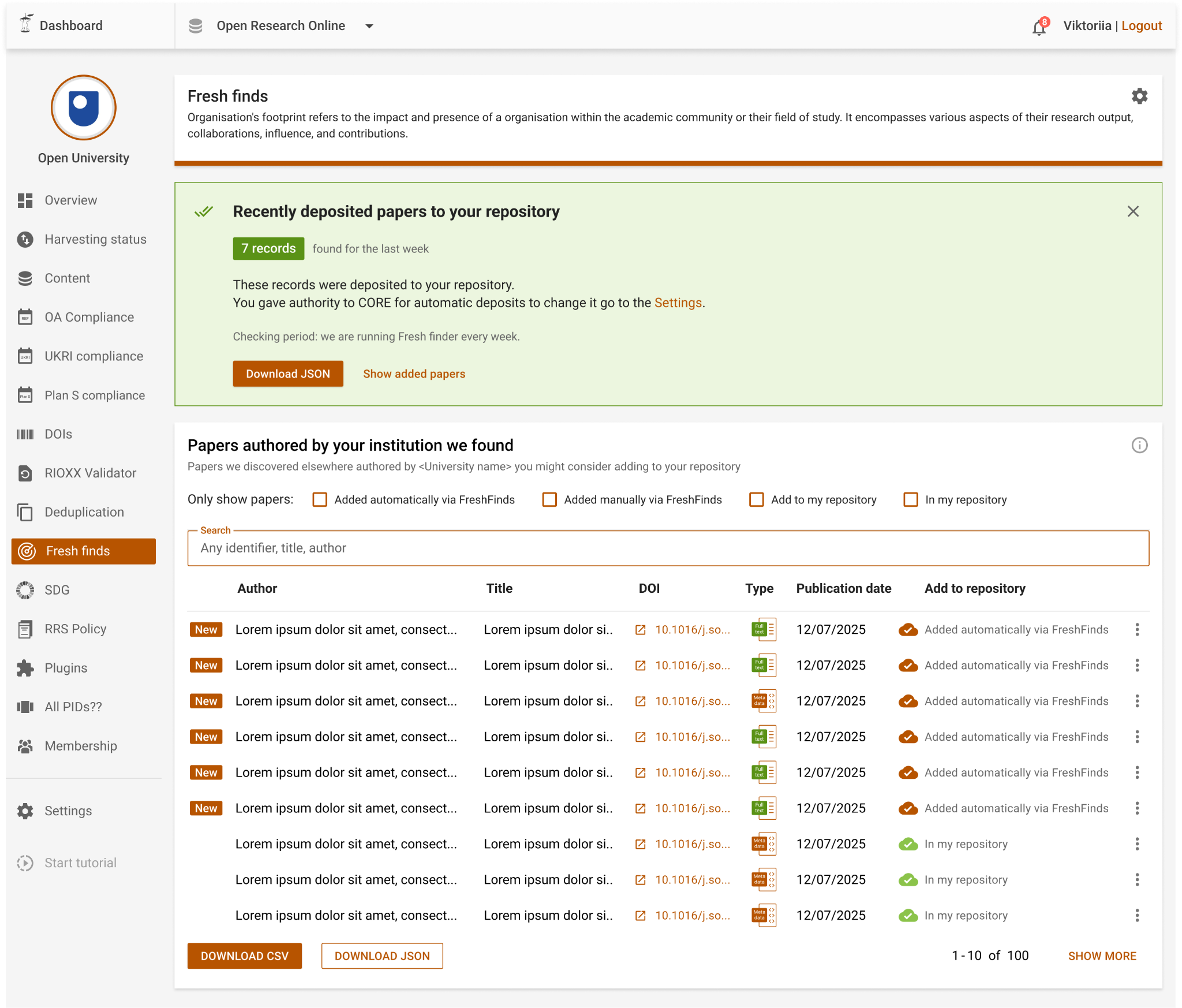
In response, CORE is actively exploring solutions, including further development of its “Fresh Finds” prototype a tool designed to identify and notify institutions of missing research outputs.
AI, ethics, and repository resilience
The rise of AI is reshaping repository management. CORE’s involvement in the COAR Task Force on AI and repositories reflects growing concern around:
- Abusive AI bots
- Responsible machine access
- Balancing openness with system protection
The discussion highlighted the need for community-aligned best practices, including shared approaches to bot management and infrastructure protection.
Advancing research through AI innovation
CORE announced its participation in a major €9 million Horizon Europe project, contributing to the development of AI-powered research assistants within the European Open Science Cloud.
This work will focus on:
- Supporting literature reviews and research workflows
- Ensuring transparency and provenance in AI outputs
- Preserving researcher credit in AI-driven environments

Community working groups: REF and FAIR
Two CORE working groups demonstrated strong engagement and practical impact:
REF 2029 Working Group
Led by David Pride, this group addressed upcoming open access requirements for REF 2029.
Key challenges identified include:
- Inconsistent metadata (particularly deposit dates)
- Limitations in repository and CRIS systems
- The need for stronger alignment with standards such as RIOXX
The group reinforced the importance of collective action when engaging system providers.
FAIR Repository Certification
Presented by Matteo Cancellieri, this initiative focuses on assessing how repositories align with FAIR principles (Findable, Accessible, Interoperable, Reusable).
CORE is developing a semi-automated certification model, combining technical checks with community input. Pilot programmes with member institutions will begin in the coming months.
Breakout discussions: real challenges, shared solutions
For the first time, the meeting introduced interactive breakout sessions, enabling deeper engagement across three themes:
- Repository services in uncertain times
- Repository management in the age of AI
- Emerging community needs
Key insights included:
- The need for replacements for discontinued services
- Ongoing challenges with metadata consistency and compliance
- The complexity of managing bot traffic across repositories
Across all discussions, one message was clear: there is no single solution; collaboration is essential.
Education, engagement, and what comes next
CORE also highlighted the launch of its educational series,The series is intended as a practical guide for repository teams who want to better understand how their content is represented in CORE and how the available tools can support day-to-day repository management.
Each release is followed by live Q&A sessions, reinforcing CORE’s commitment to accessible, ongoing learning.
The meeting closed with a strong call for continued engagement particularly through the CORE community survey, which directly informs the development roadmap.
As CORE continues to grow, the direction remains clear:
build infrastructure with the community, not just for it.