On 1 July, Jisc’s Publications Router was switched off after nearly a decade of quietly piping metadata and manuscripts into institutional repositories. If you manage a repository, you have probably spent the past few weeks watching that particular feed go quiet.
With this instalment of our educational series we begin exploring the OA Compliance tab in the CORE Dashboard. Over the next three instalments we will look at the different compliance views the Dashboard offers: REF2029, the RIOXX metadata validator, and the Desirable Characteristics Report. We start with REF2029.
What the REF2029 tab does
The REF2029 tab provides dedicated tools for monitoring how your repository is performing against REF2029 open access requirements. At present, we track the duration between a paper’s deposit and its official publication. CORE compiles this information from repository metadata, as detailed in the CORE recommendations for REF.read more...
The Content tab is the central location for managing the information CORE holds about your repository. It provides repository managers with a complete view of the outputs indexed by CORE and offers tools for reviewing content, checking availability, managing visibility, and responding to content removal requests.
In this installment of the CORE Dashboard Educational Series, we explore the key features of the Content tab and how they can support day-to-day repository management.
The Content tab is for the general management of all the information that CORE holds about your repository. It lists all the papers that CORE was able to index from your repository. If the number of outputs visible in CORE doesn’t match the number of outputs in your repository, you can investigate the reason by making sure that your repository is compliant with the CORE Data Provider’s Guide. Any issues we may have detected with your repository shown in theIndexing status tab are also a good indicator for understanding the difference.read more...
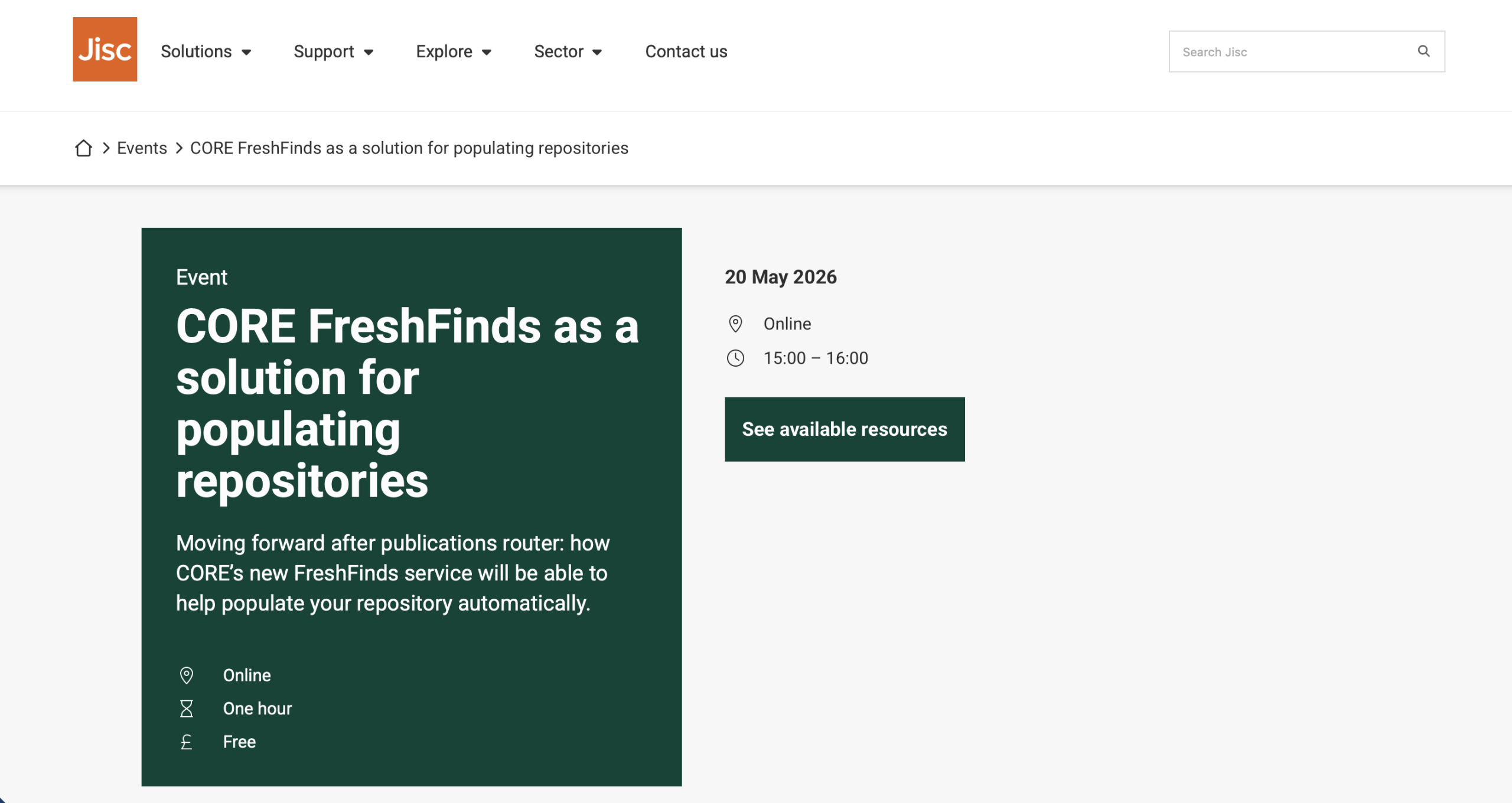
Last week, CORE and Jisc hosted a webinar on the development of CORE FreshFinds as a solution for populating repositories following the retirement of Publications Router.
The discussion brought together repository managers and members of the scholarly communications community to explore questions around repository workflows, metadata quality, full text discovery, interoperability, deposit workflows, and sustainable open infrastructure.
During the session, Petr Knoth shared the development roadmap for FreshFinds and discussed how CORE’s existing indexing and full text processing infrastructure is being used to support repository teams in identifying newly published research outputs that may not yet be present in institutional repositories.read more...
The recent announcement to retire Jisc Publications Router has prompted important conversations across the repositories community about how institutions currently relying on these workflows will continue identifying and managing newly published research outputs that have not yet been deposited in their repositories.
For repository teams, these workflows play an important role in maintaining comprehensive and timely institutional records of scholarly outputs while reducing the administrative burden placed on researchers and repository staff. Reliance on manual deposit workflows can create significant overheads for repository teams and make it more difficult for institutions to maintain a comprehensive scholarly record. In some institutions, automated deposit workflows also play an important role in supporting compliance with open access policies and related reporting requirements. As institutions review how these workflows will continue following the retirement of Publications Router, many are also considering what replacement infrastructure may emerge to support these processes in the future.read more...
In our most recent CORE newsletter, we shared updates across CORE’s services, partnerships, and community initiatives, reflecting continued progress in advancing open access and strengthening global repository infrastructure.
As part of this ongoing evolution, the CORE Advisory Board has been refreshed, bringing together an internationally diverse group of experts whose collective insight continues to guide CORE’s direction.
An important part of that progress sits behind the scenes: ensuring that CORE remains closely aligned with the needs, priorities, and realities of the global research community.read more...
In just 17 days, CORE will be taking part in The Big Migration Conference, a gathering of people working across repositories, libraries, and research infrastructure to shape how scholarly communication continues to evolve.
We’re looking forward to contributing two closely connected sessions that sit at the heart of what we care about at CORE: helping repositories not just participate in open science, but genuinely thrive within it.
The first session, Connecting Repositories, will be presented by Professor Petr Knoth. It offers an overview of CORE as an open scholarly infrastructure indexing millions of open access research outputs from repositories and journals around the world. Beyond the scale, the focus is on what this enables in practice from improving discoverability and reuse of research, to supporting interoperability, metadata quality, and compliance in increasingly complex research environments. It will also touch on some of the work coming out of the Big Scientific Data and Text Analytics Group, including CORE-GPT for trustworthy question answering over scholarly literature, SDG classification of research outputs, and SoFAIR, which supports reproducibility and research software management.read more...
Community, infrastructure, and the future of open research
On 15 April 2026, CORE welcomed its global community of members to the biannual Board of Supporters meeting , a session that brought together strategic updates, collaborative discussions, and forward-looking priorities shaping the future of open research infrastructure.
With participation from repository managers, institutional stakeholders, and CORE leadership, the meeting reinforced one central theme: community-led development remains at the heart of CORE’s evolution.read more...
As part of our ongoing CORE Dashboard Educational Series, this second installment focuses on the Indexing Status tab. This tab provides detailed insights into how CORE indexes your repository, highlights any issues, and offers actionable information to help you manage and improve repository visibility. Whether you’re a repository manager, librarian, or scholarly communications professional, understanding these metrics is key to maintaining high-quality, discoverable content.
All information about indexing your repository by CORE is placed under the “Indexing Issues” tab. It contains all details, numbers, dates, and issues that can be useful for repository managers managing repositories. In the “Indexing status” tab, we have 4 main sections:read more...
In November 2025, CORE publicly announced its strategic support for the creation of the Ukrainian open repositories community, led by the Scientific and Technical Library of Igor Sikorsky Kyiv Polytechnic Institute. At the time, we described this partnership as both a strategic and deeply personal commitment rooted in solidarity, collaboration, and long-term investment in Ukraine’s open research infrastructure.
Today, that commitment continues in practice.
On 25 February 2026, CORE will take part in a dedicated webinar hosted in partnership with The KPI Library, designed specifically for Ukrainian librarians, researchers, and repository administrators and delivered in Ukrainian.read more...
Manage Consent
To provide the best experiences, we use technologies like cookies to store and/or access device information. Consenting to these technologies will allow us to process data such as browsing behaviour or unique IDs on this site. Not consenting or withdrawing consent, may adversely affect certain features and functions.
Functional
Always active
The technical storage or access is strictly necessary for the legitimate purpose of enabling the use of a specific service explicitly requested by the subscriber or user, or for the sole purpose of carrying out the transmission of a communication over an electronic communications network.
Preferences
The technical storage or access is necessary for the legitimate purpose of storing preferences that are not requested by the subscriber or user.
Statistics
The technical storage or access that is used exclusively for statistical purposes.The technical storage or access that is used exclusively for anonymous statistical purposes. Without a subpoena, voluntary compliance on the part of your Internet Service Provider, or additional records from a third party, information stored or retrieved for this purpose alone cannot usually be used to identify you.
Marketing
The technical storage or access is required to create user profiles to send advertising, or to track the user on a website or across several websites for similar marketing purposes.