
08 May 2026
The recent announcement to retire Jisc Publications Router has prompted important conversations across the repositories community about how institutions currently relying on these workflows will continue identifying and managing newly published research outputs that have not yet been deposited in their repositories.
For repository teams, these workflows play an important role in maintaining comprehensive and timely institutional records of scholarly outputs while reducing the administrative burden placed on researchers and repository staff. Reliance on manual deposit workflows can create significant overheads for repository teams and make it more difficult for institutions to maintain a comprehensive scholarly record. In some institutions, automated deposit workflows also play an important role in supporting compliance with open access policies and related reporting requirements. As institutions review how these workflows will continue following the retirement of Publications Router, many are also considering what replacement infrastructure may emerge to support these processes in the future.
These challenges are not new. Through our ongoing discussions with repository managers and feedback shared through the CORE Board of Supporters community, CORE (COnnecting REpositories) has been hearing for some time about the growing operational burden associated with manual deposit workflows and the difficulty of maintaining comprehensive institutional records of scholarly outputs.
CORE provides a comprehensive bibliographic database of the world’s scholarly literature by connecting repositories, journals and other scholarly data sources from around the world. This existing infrastructure gives CORE a unique overview of newly emerging scholarly content and repository coverage across the global research landscape.
In 2025, CORE started developing FreshFinds in response to this community feedback, and an initial prototype of the system has already been implemented and demonstrated to a small number of repositories. The retirement of Publications Router has, however, further highlighted the importance of these workflows across the community and accelerated the need for sustainable infrastructure supporting repository deposit processes.
FreshFinds is a new workflow support module within CORE designed to help institutions identify newly published papers authored by their researchers which may not yet be present in their repositories. FreshFinds is intended to support repository deposit workflows and provide continuity for institutions following the retirement of Publications Router.
Following the announcement of the retirement of Publications Router, CORE is therefore prioritising the further development and operationalisation of FreshFinds as part of its broader commitment to supporting repositories and open scholarly infrastructure.
—-
On 20 May 2026 from 3 – 4 pm UK time , CORE and Jisc will jointly host a webinar in which we will be able to share with you more information about the development of CORE FreshFinds.
To follow the development of CORE FreshFinds and receive information about the upcoming webinar, please register your interest here: CORE FreshFinds Updates Form
—-
Highlights
How FreshFinds Will Operate
FreshFinds is designed to support repository teams throughout the publication discovery and deposit workflow.
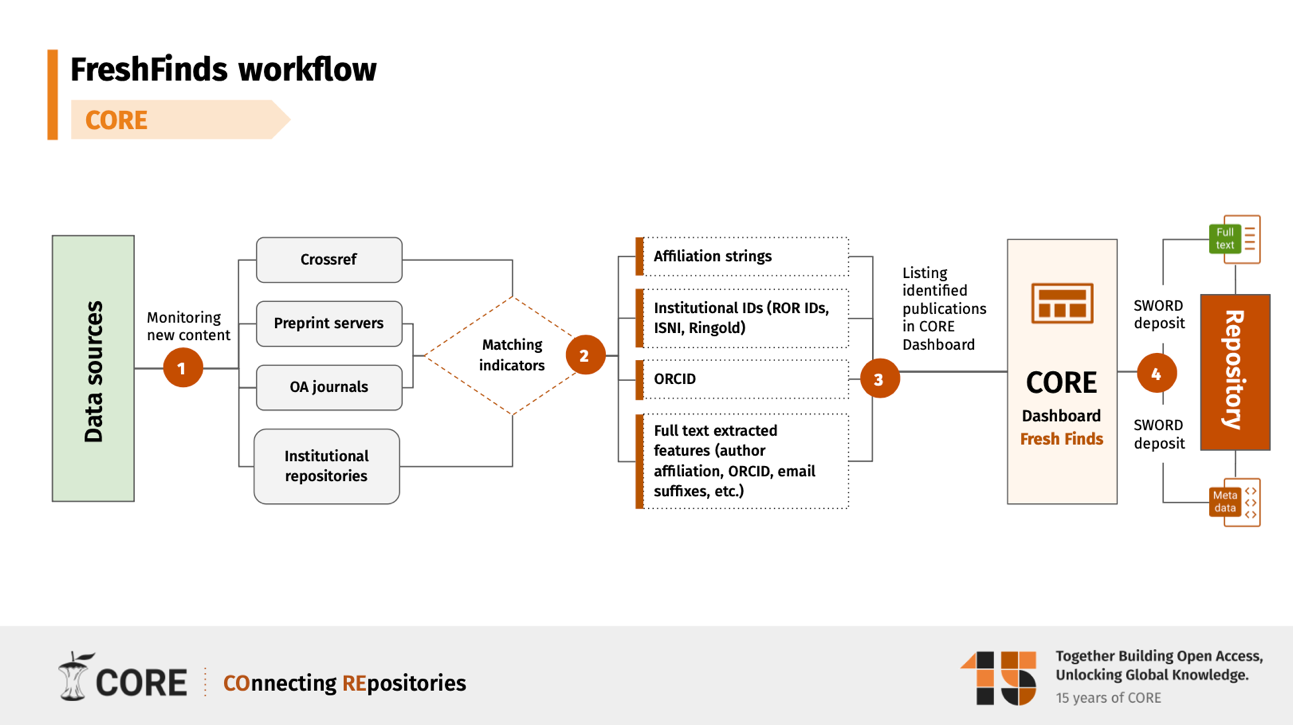
CORE continuously monitors newly published research outputs across a wide range of sources, including bibliographic databases, repositories, preprint servers and open access journals. The FreshFinds system combines signals available in metadata, such as affiliation strings, ROR IDs and ORCID identifiers, with institutional signals that can be extracted directly from publication full texts, including affiliation information in publication headers and contact email domains, in order to identify papers likely authored by researchers affiliated with a given institution.
This full text analysis capability is particularly important because institutional affiliation information is often incomplete in scholarly metadata. CORE’s analysis of Crossref metadata conducted last year indicated that only around 14% of records contained a ROR identifier and only around an additional 14% included affiliation strings. CORE FreshFinds therefore also builds on CORE’s large-scale full text processing infrastructure to improve identification coverage and accuracy beyond what is typically possible using metadata alone.
The service is also being designed with awareness of existing repository holdings. Historically, repository deposit workflows have not always had visibility of content already present within institutional repositories, sometimes leading to duplicate deposits and additional manual processing. By combining repository intelligence with deduplication mechanisms, CORE FreshFinds aims to reduce unnecessary duplication while supporting repository teams in maintaining accurate and comprehensive institutional records.
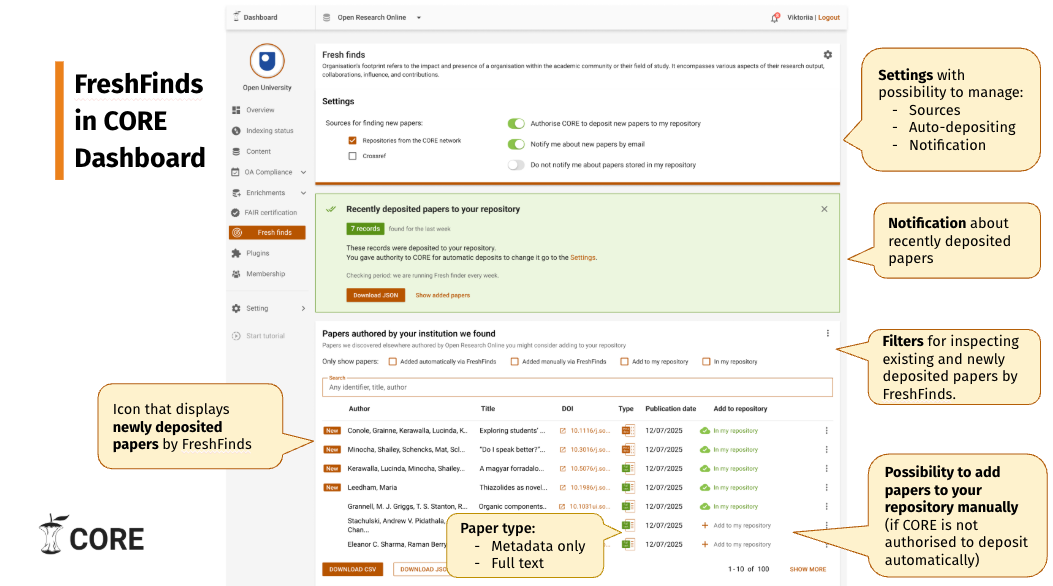
Identified publications are surfaced through the CORE Dashboard, where repository teams can review newly discovered outputs, configure notifications and manage deposit workflows. Where supported, FreshFinds will also support automated or semi-automated deposits into repositories using SWORD-based workflows.
The objective is not simply to identify papers, but to support repositories in maintaining comprehensive institutional records while lowering the operational overhead associated with deposit workflows.
What CORE FreshFinds Will Add
CORE FreshFinds is being designed not only to support continuity for repository deposit workflows, but also to build on CORE’s existing large-scale scholarly index and full text processing infrastructure.
One of the original objectives behind FreshFinds was to lower the barrier for institutions to benefit from publication discovery and deposit workflow technologies of this kind. CORE FreshFinds is therefore being designed to support a broader range of repository workflows across institutions, including those whose repository systems may not support SWORD-based deposit workflows.
In addition to monitoring newly published content from major bibliographic databases and metadata providers such as Crossref, CORE FreshFinds is also intended to support discovery across a broader range of open scholarly infrastructure sources, including repositories, preprint servers and open access journals. This broader source coverage is intended to help institutions identify relevant research outputs beyond traditional publisher-centric workflows.
The system is also being designed with awareness of existing repository holdings. By taking into account content already present within institutional repositories, CORE FreshFinds aims to reduce duplicate deposits and unnecessary manual processing while supporting repository teams in maintaining accurate and comprehensive institutional records.
CORE FreshFinds is also intended to integrate directly with the CORE Dashboard through a dedicated workflow management interface. Repository teams will be able to review newly identified publications, configure notifications and manage deposit workflows directly within the dashboard environment.
The system is being designed to support multiple operational modes. Institutions with support for SWORD-based deposit workflows will be able to configure more automated ingestion pipelines, while other institutions will still be able to benefit from discovery, review and export workflows through the CORE Dashboard irrespective of repository platform or technical integration maturity.
CORE also intends to prioritise scalable and interoperable approaches to content discovery. Rather than relying on bespoke integrations with individual publishers, CORE FreshFinds is being developed around large-scale bibliographic databases and indexing workflows. This approach is intended to support sustainability, scalability and broad institutional coverage over time.
We also want to acknowledge the important contribution that Jisc Publications Router has made over many years in supporting repository workflows across the UK repository community.
As these workflows evolve, we believe it is important that the community continues to have open, sustainable and interoperable infrastructure that supports repositories and reduces administrative burden for institutions and researchers alike.
We look forward to continuing these conversations with the community in the coming weeks and months.